
From Assembly Lines to AI Workforces: Why Software Engineering Is Entering Its Next Operational Revolution
Sainath Jogdand
Engineering Leader • Strategic Technology Advisor at PUR2DIVIN INNOVATIONS • Executive MBA Candidate (WashU & IIT Bombay)
"Efficiency is doing things right. Effectiveness is doing the right things."— Peter Drucker
Summary
For more than a century, industries such as manufacturing, pharmaceuticals, aerospace, and semiconductor fabrication have continuously evolved—not simply by introducing better machines, but by fundamentally changing how work is organized.
Early manufacturing relied on skilled craftsmen who built products from start to finish. While this approach produced remarkable craftsmanship, it struggled to scale. Production depended heavily on individual expertise, quality varied, and output was difficult to predict.
The Industrial Revolution changed that paradigm.
Assembly line production did far more than accelerate manufacturing. It redefined production itself. Work was decomposed into specialized responsibilities, coordinated through standardized processes, governed by quality controls, and continuously optimized. Productivity increased not because individual workers became dramatically more capable, but because the entire operational system became better organized.
The same pattern can be observed across modern industries. Pharmaceutical companies coordinate research, clinical trials, regulatory approvals, manufacturing, and distribution through governed operational systems. Airlines synchronize aircraft, crews, maintenance, and passenger operations through centralized control centers. Semiconductor manufacturers orchestrate thousands of precision manufacturing processes across fabrication facilities.
Despite their differences, these industries share one common principle.
Evolution of Industrial Operations
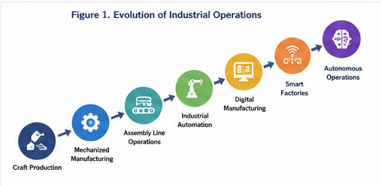
The evolution of industrial operations demonstrates that every generation of innovation introduced a better way to coordinate people, processes, and technology.
Rather than focusing solely on automation, industries continuously improved operational coordination.
Craft Production Mechanized Manufacturing Assembly Line Operations Industrial Automation Digital Manufacturing Smart Factories Autonomous Operations
Each stage built upon the previous one, increasing scalability, consistency, operational visibility, and productivity.
The Modern Manufacturing Operating Model
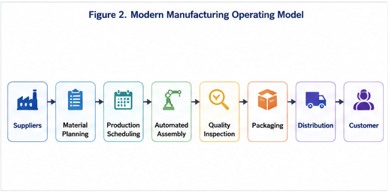
Modern manufacturing no longer operates as isolated departments.
Instead, it functions as an integrated operational ecosystem where every stage contributes to a shared production objective.
Core operational capabilities include:
- Supplier Management
- Material Planning
- Production Scheduling
- Manufacturing Operations
- Quality Management
- Packaging
- Distribution
- Customer Delivery
Information flows continuously across these functions, enabling predictable production, quality assurance, and continuous operational improvement.
This naturally raises an important question.
If manufacturing transformed itself through operational systems, is software engineering approaching a similar turning point?
Is Software Engineering Approaching the Same Turning Point?
Software engineering has experienced remarkable technological progress over the past two decades.
Organizations have embraced modern engineering practices together with a rich ecosystem of technologies and platforms, including cloud computing, continuous delivery, infrastructure automation, observability, platform engineering, and AI-assisted software development.
Engineering teams also rely on specialized platforms throughout the software lifecycle, including:
- Source code repositories (e.g., GitHub, GitLab, Bitbucket)
- Work management platforms (e.g., Jira, Azure Boards, Linear)
- Collaboration platforms (e.g., Slack, Microsoft Teams)
- Documentation and knowledge platforms (e.g., Confluence, Notion, SharePoint)
- AI assistants and foundation models (e.g., ChatGPT, Claude, Gemini, Copilot)
- CI/CD and automation platforms
- Testing and quality platforms
- Security and DevSecOps platforms
- Cloud platforms
- Monitoring and observability platforms
These innovations have significantly improved how software is built.
Yet software organizations continue to rely on numerous specialized teams working across separate tools, workflows, approvals, and communication channels.
Typical product organizations include:
- Product Management
- Business Analysis
- User Experience Design
- Architecture
- Engineering
- Quality Engineering
- Security Engineering
- Platform Engineering
- Site Reliability Engineering
- Operations
- Customer Success
The software industry has made remarkable progress in optimizing individual engineering functions. However, coordinating these functions as a unified operational system remains an area of ongoing evolution and innovation.
Despite advances in automation and AI, organizations continue to invest significant effort in meetings, documentation, approvals, work tracking, communication, context sharing, and cross-functional coordination.
Today's Software Delivery Model
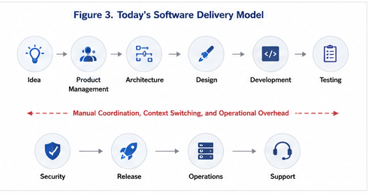
Modern software delivery is supported by a mature ecosystem of engineering platforms and tools. However, these platforms primarily optimize individual stages of the software lifecycle rather than the operational coordination across the entire product organization.
Work still progresses through multiple specialized teams before reaching customers.
At every transition, organizations risk:
Context loss Communication delays Manual coordination Duplicate effort Operational overhead
As software products become increasingly complex, these coordination challenges become more pronounced.
AI Improved Individual Productivity. What Comes Next?
Artificial Intelligence has fundamentally changed how software professionals work.
Developers generate code more quickly. Architects evaluate design alternatives more efficiently. Product managers accelerate analysis and documentation. Testers automate repetitive validation. AI is rapidly becoming part of everyday software engineering.
These advances represent a significant leap in individual productivity.
However, the next challenge extends beyond individual productivity.
Organizations must now consider questions such as:
How do human teams and AI agents collaborate effectively? How is organizational knowledge preserved across people and AI? How is governance maintained? How are business priorities continuously aligned? How do AI agents coordinate across the entire product lifecycle?
These questions extend beyond the capabilities of individual AI assistants.
They point toward the need for a new operational model.
Our Exploration
At P2D, these questions have become the foundation of our ongoing exploration.
Through the PURION (Productive Unified Reasoning & Intelligence Operations Network, originally investigated through the P2D Command Center), we are investigating what we call Agentic Product Operations—an emerging operational approach that explores how human teams and AI agents might collaborate as a coordinated software product organization.
This work is still evolving, and our objective is not to claim a definitive solution. Rather, it is to contribute to the broader conversation around how software engineering may evolve in the era of Enterprise AI.
This leads to a compelling question:
From AI Assistants to an Enterprise AI Workforce
The First Wave of AI Focused on Individuals
Artificial Intelligence has become an integral part of modern software engineering.
Today, AI assists software professionals across the product lifecycle. Engineers generate code more efficiently, architects evaluate design alternatives, product managers accelerate analysis and documentation, testers automate repetitive validation, and operations teams streamline repetitive tasks.
These capabilities represent an important shift.
For the first time, AI has become an active participant in software engineering rather than simply another development tool.
Yet most AI adoption today remains centered around individual productivity.
An engineer works with an AI assistant.
A product manager works with another AI assistant.
A tester uses a different AI capability.
Each interaction improves a single person's work.
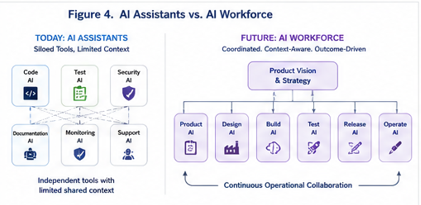
This model delivers measurable productivity gains, but it introduces a new challenge.
As organizations deploy more AI capabilities, they are managing not one AI assistant, but potentially hundreds of specialized AI workers operating across different functions.
The question shifts from:
to
The Coordination Challenge
Software products are not built by individuals.
They are built by coordinated product organizations.
Ideas move through product management, architecture, engineering, quality engineering, security, platform engineering, operations, customer support, and business stakeholders.
Every decision depends upon organizational context.
Business priorities evolve.
Requirements change.
Architecture changes.
Policies change.
Customer feedback changes.
Compliance requirements evolve.
For humans, much of this coordination happens through conversations, meetings, documents, tickets, emails, dashboards, and shared experience.
As AI agents become active contributors, they must participate within this same organizational context.
Without coordinated operations, AI agents risk becoming isolated contributors that lack awareness of:
Business objectives Product strategy Organizational policies Technical architecture Team priorities Governance Previous decisions Cross-functional dependencies
The challenge is no longer generating intelligent responses.
The challenge becomes coordinating intelligent participants.
Beyond Individual Intelligence
Industries rarely achieve transformation by improving isolated workers.
Transformation occurs when entire operational systems evolve.
Software engineering may be approaching a similar moment.
Instead of viewing AI as a collection of independent assistants, organizations may begin viewing AI as a coordinated workforce operating alongside human teams.
This represents a shift in perspective.
Instead of asking:
Organizations may begin asking:
Which AI workers do we need? What responsibilities should each AI worker have? How should they collaborate? Who governs their work? How is organizational knowledge shared? How are outcomes measured? How do humans remain in control?
These questions resemble organizational design more than software configuration.
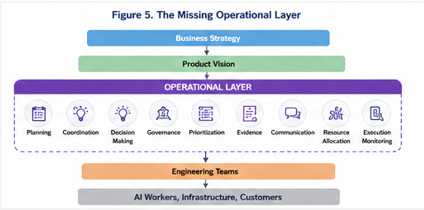
What Is an Enterprise AI Workforce?
An Enterprise AI Workforce is not simply a collection of AI models.
It is an organizational concept where specialized AI agents perform defined roles, collaborate with human teams, operate within organizational policies, and contribute toward shared business outcomes.
Like human teams, AI workers may specialize across the software product lifecycle, taking on responsibilities such as product strategy, business analysis, architecture, engineering, testing, security, release management, customer support, and organizational knowledge management.
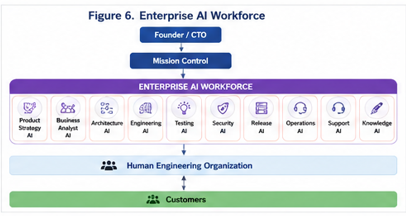
While the Enterprise AI Workforce is a conceptual model, it may be composed of multiple specialized AI workers performing distinct responsibilities across the software product lifecycle.
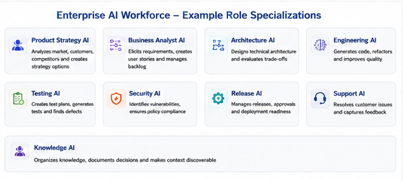
The objective is not to replace human expertise.
Instead, it is to augment product organizations with specialized AI workers that collaborate with people, operate within organizational policies, share organizational context, and remain under human leadership and governance.
The Missing Layer
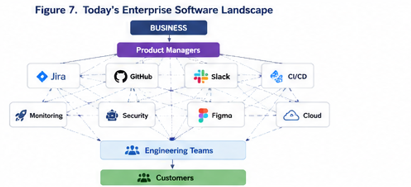
Today's engineering organizations already have excellent engineering platforms.
They use source code repositories, work management platforms, documentation systems, collaboration platforms, AI assistants, CI/CD pipelines, cloud platforms, security platforms, and observability solutions.
Each platform optimizes a specific activity.
However, none of these platforms is designed to coordinate an Enterprise AI Workforce across the entire product lifecycle.
This suggests the possibility of a missing operational layer.
Not another engineering tool.
Not another AI assistant.
But an operational capability responsible for coordinating people, AI agents, organizational knowledge, governance, and execution.
Our Exploration
These observations form the basis of our ongoing exploration.
At P2D, we are investigating what this operational layer could look like through the PURION (Productive Unified Reasoning & Intelligence Operations Network, originally investigated through the P2D Command Center) and our concept of Agentic Product Operations.
Our hypothesis is that as AI becomes an active participant in software engineering, organizations may require an operational model capable of coordinating both human teams and AI agents across the product lifecycle.
We do not present this as a completed solution or an industry standard.
Rather, it is an evolving exploration intended to contribute to the broader discussion about the future of software product engineering.
Toward an Enterprise AI Workforce Operating System
From Engineering Platforms to Operational Systems
Software engineering has developed a rich ecosystem of technologies over the past two decades.
Organizations now rely on specialized platforms throughout the software product lifecycle, including source code repositories, project and work management systems, documentation platforms, collaboration tools, AI assistants, CI/CD pipelines, cloud platforms, security platforms, monitoring platforms, and developer productivity tools.
Each of these technologies has significantly improved a specific aspect of software engineering.
Collectively, they have transformed how software is planned, built, tested, deployed, and operated.
However, software delivery still depends on extensive coordination between people, teams, business functions, and increasingly, AI.
The opportunity is no longer simply building better engineering tools.
It is understanding how all of these capabilities can operate together as a coordinated operational system.
An Emerging Operational Layer
As organizations adopt AI across the software lifecycle, software engineering begins to resemble a coordinated workforce rather than a collection of independent contributors.
Human teams and AI agents both contribute to planning, implementation, testing, operations, documentation, and decision-making.
Coordinating this workforce introduces new operational questions.
Organizations may need to understand:
Which AI agents should participate in a product? What responsibilities should each AI agent perform? How should organizational knowledge be shared? How should work be coordinated across teams? How should governance and approvals be maintained? How should business priorities be reflected in AI execution? How should outcomes be measured?
These questions extend beyond the capabilities of today's engineering platforms.
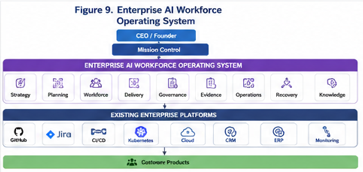
They suggest the need for an operational layer capable of coordinating both human teams and AI agents.
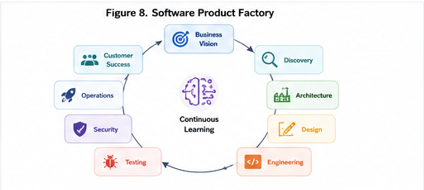
Rather than replacing existing engineering platforms, this operational layer could connect them, providing coordination, organizational context, governance, and operational visibility across the entire software product lifecycle.
Characteristics of an Enterprise AI Workforce Operating System
Although this concept continues to evolve, an Enterprise AI Workforce Operating System could provide capabilities such as:
- Enterprise AI Workforce management
- Human and AI collaboration
- Organizational context management
- Product and business context inheritance
- Work orchestration
- Operational governance
- Knowledge management
- Operational visibility
- Decision traceability
- Continuous learning and improvement
The objective is not to replace existing engineering platforms.
Instead, it is to coordinate how people, AI agents, organizational knowledge, and engineering activities work together.
Agentic Product Operations
As Enterprise AI Workforces evolve, software product operations may also evolve.
Traditional Product Operations primarily coordinate people, processes, and delivery activities.
An emerging operational model may also coordinate AI agents, organizational knowledge, business priorities, governance, and engineering execution.
We refer to this evolving discipline as Agentic Product Operations.
Rather than introducing another engineering methodology, Agentic Product Operations explores how software organizations may operate when AI becomes an active participant throughout the product lifecycle.
Our Exploration with the P2D Command Center
These ideas form the foundation of our ongoing exploration.
Through the PURION (Productive Unified Reasoning & Intelligence Operations Network, originally investigated through the P2D Command Center), we are exploring how Agentic Product Operations and an Enterprise AI Workforce Operating System might be implemented within modern software organizations.
Our focus is not on replacing the engineering platforms organizations already use.
Instead, we are investigating how existing technologies, organizational knowledge, human expertise, and AI agents can work together through a unified operational model.
Current areas of exploration include:
Enterprise AI Workforce coordination AI squads and team collaboration Organizational context management Human-in-the-loop operations Governance and operational policies Product lifecycle orchestration Operational observability Continuous improvement
This work is still evolving.
Our intention is not to present a definitive solution, but to contribute to the broader conversation around how software engineering may evolve as AI becomes an integral part of product organizations.
Looking Ahead
Software engineering has spent decades improving how software is built.
The next opportunity may lie in improving how software organizations operate.
Whether this evolution ultimately takes the form of Enterprise AI Workforces, Agentic Product Operations, or entirely new operational models, one trend appears increasingly clear.
AI is becoming part of the organization—not simply another development tool.
The Future Software Product Factory
Every Industry Eventually Evolves Its Operating Model
Throughout history, transformative technologies have rarely changed industries on their own.
Lasting transformation has occurred when industries developed new ways to organize people, processes, technology, and information into coordinated operational systems.
Manufacturing evolved from individual craftsmanship to intelligent factories.
Financial services evolved from manual operations to real-time digital ecosystems.
Healthcare continues to evolve through connected care models.
Software engineering may now be approaching a similar transition.
Artificial Intelligence is changing how software is created.
The next opportunity may lie in rethinking how software organizations themselves operate when humans and AI become collaborative participants throughout the product lifecycle.
The Future Software Product Organization
Future software organizations may operate differently from today's engineering teams.
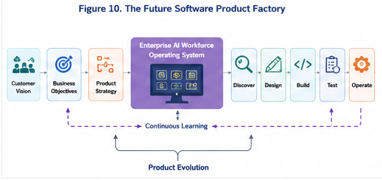
Rather than coordinating only human contributors, organizations may coordinate human teams and specialized AI agents working together toward common product objectives.
Operational systems may become responsible for continuously coordinating:
- Human expertise
- AI agents
- Organizational knowledge
- Business priorities
- Product strategy
- Governance
- Engineering execution
- Continuous learning
This represents an evolution in organizational operations rather than simply another advancement in software development tools.
Human Leadership Remains Central
As AI capabilities continue to advance, the importance of human leadership does not diminish.
Instead, it becomes even more significant.
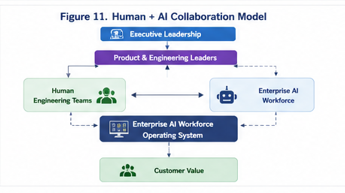
People continue to provide vision, strategy, creativity, ethics, governance, customer understanding, and organizational leadership.
AI contributes speed, scale, consistency, automation, and analytical capability.
The future is unlikely to be defined by humans or AI working independently.
It is more likely to be defined by effective collaboration between both.
Technology should augment human capability, not replace human responsibility.
From Concept to Practice
The ideas presented in this paper are not intended to remain theoretical.
At Pur2Divin Innovations, we are exploring these concepts through the PURION (Productive Unified Reasoning & Intelligence Operations Network, originally investigated through the P2D Command Center), an evolving platform for Agentic Product Operations. Our objective is to better understand how human teams and AI agents can collaborate through a coordinated operational model while continuing to leverage the engineering platforms and technologies organizations already use.
One of the first products being developed on this platform is E-Divin, an AI-native Education Operating System.
E-Divin provides an opportunity to apply, validate, and continuously refine the concepts discussed in this paper within a real-world product environment.
Our long-term vision is to demonstrate that complex software products can be conceived, designed, developed, operated, and continuously evolved through coordinated collaboration between human expertise and AI capabilities.
This journey is still in its early stages, and we expect both the ideas and the platform to evolve through experimentation, customer feedback, and collaboration with the broader technology community.
An Invitation to Explore Together
The concepts presented in this paper are intended to contribute to a broader industry conversation.
Enterprise AI Workforces, Enterprise AI Workforce Operating Systems, and Agentic Product Operations represent one possible perspective on how software product engineering may evolve as AI becomes an increasingly active participant in organizations.
We do not present these ideas as industry standards or completed solutions.
Rather, they are part of an ongoing exploration that we hope encourages discussion, experimentation, collaboration, and innovation across the software engineering community.
Closing Thoughts
Every generation of software engineering has been shaped by a defining shift.
Programming languages made software development accessible.
Version control enabled collaboration.
Cloud computing transformed infrastructure.
Automation accelerated software delivery.
Artificial Intelligence is transforming individual productivity.
The next evolution may not be another engineering tool.
It may be a new operational model that enables humans and AI to work together as a coordinated software product organization.
Whether that future ultimately takes the form of Enterprise AI Workforces, Agentic Product Operations, or entirely different operational models remains to be seen.
What seems increasingly clear is that the conversation is no longer about whether AI will participate in software engineering.
The conversation is about how humans and AI will work together to create the next generation of software products.
The future is not yet defined.
Together, we have an opportunity to help shape it.
Sainath Jogdand is an Engineering Leader, Executive MBA Candidate at Washington University in St. Louis and IIT Bombay, and Strategic Technology Advisor at Pur2Divin Innovations.
His work focuses on the future of software product engineering, Enterprise AI Workforces, Enterprise AI Workforce Operating Systems, and Agentic Product Operations.
At Pur2Divin Innovations, he is leading the exploration of these concepts through PURION (Productive Unified Reasoning & Intelligence Operations Network) and building E-Divin, an AI-native Education Operating System, as a real-world implementation to validate how human teams and AI agents can collaboratively design, build, operate, and continuously evolve software products.
He welcomes discussions and collaboration with technology leaders, researchers, founders, engineers, and enterprise organizations exploring the next generation of AI-enabled product development.